

Wi-Fi is a wireless networking technology based on IEEE 802.11 standards that enables devices to connect to local networks and the Internet without physical cables. Wi-Fi uses radio waves to transmit data over short to medium distances. It is common in homes, offices, and public spaces.
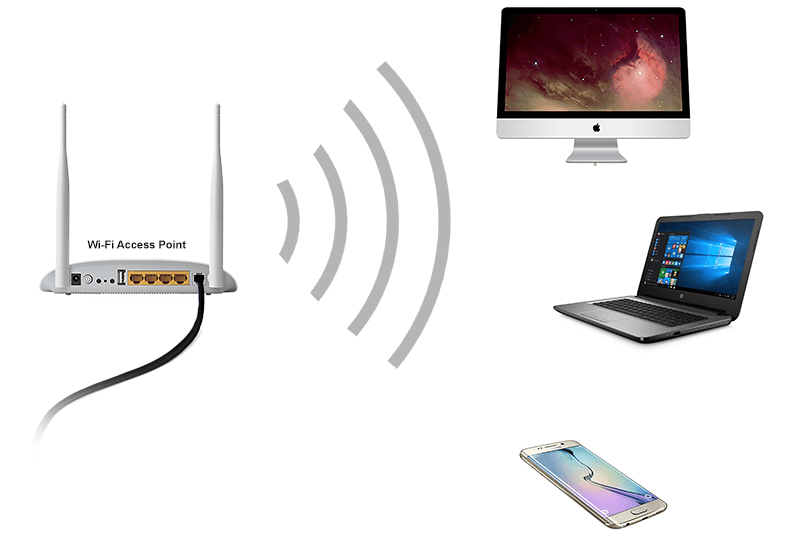
Wi-Fi allows devices such as computers, smartphones, tablets, and IoT devices to connect to a wireless access point (AP), which typically provides connectivity to a wired local network and the internet. Communication occurs using radio waves in unlicensed frequency bands, most commonly 2.4 GHz, 5 GHz, and 6 GHz, with different IEEE 802.11 amendments specifying performance characteristics such as throughput, range, and efficiency.
The table below lists the main Wi-Fi standards, showing their IEEE designations, operating frequency bands, and maximum theoretical data rates.
| Common Name | IEEE Standard | Wi-Fi Generation | Frequency Band | Maximum Data Rate |
|---|---|---|---|---|
| Wireless B | 802.11b | Wi-Fi 1 | 2.4 GHz | 11 Mbps |
| Wireless A | 802.11a | Wi-Fi 2 | 5 GHz | 54 Mbps |
| Wireless G | 802.11g | Wi-Fi 3 | 2.4 GHz | 54 Mbps |
| Wireless N | 802.11n | Wi-Fi 4 | 2.4 / 5 GHz | Up to 600 Mbps |
| Wireless AC | 802.11ac | Wi-Fi 5 | 5 GHz | Up to 6.9 Gbps |
| Wi-Fi 6 | 802.11ax | Wi-Fi 6 | 2.4 / 5 GHz | Up to 9.6 Gbps |
| Wi-Fi 6E | 802.11ax | Wi-Fi 6E | 6 GHz | Up to 9.6 Gbps |
| Wi-Fi 7 | 802.11be | Wi-Fi 7 | 2.4 / 5 / 6 GHz | Up to 46 Gbps |
Modern Wi-Fi standards support features including encryption and authentication (for example, WPA2 and WPA3), multiple-input multiple-output (MIMO) antennas, channel bonding, and quality of service (QoS) to improve security, reliability, and performance in environments with many connected devices. The term Wi-Fi is a trademark used by the Wi-Fi Alliance to indicate devices that have been certified for interoperability with IEEE 802.11 standards.